How to evaluate brand-agnostic OLP software in 2026
A practical guide to evaluating offline programming software. Learn what separates narrow tools from complete platforms across processes, simulation scope, and total cost.
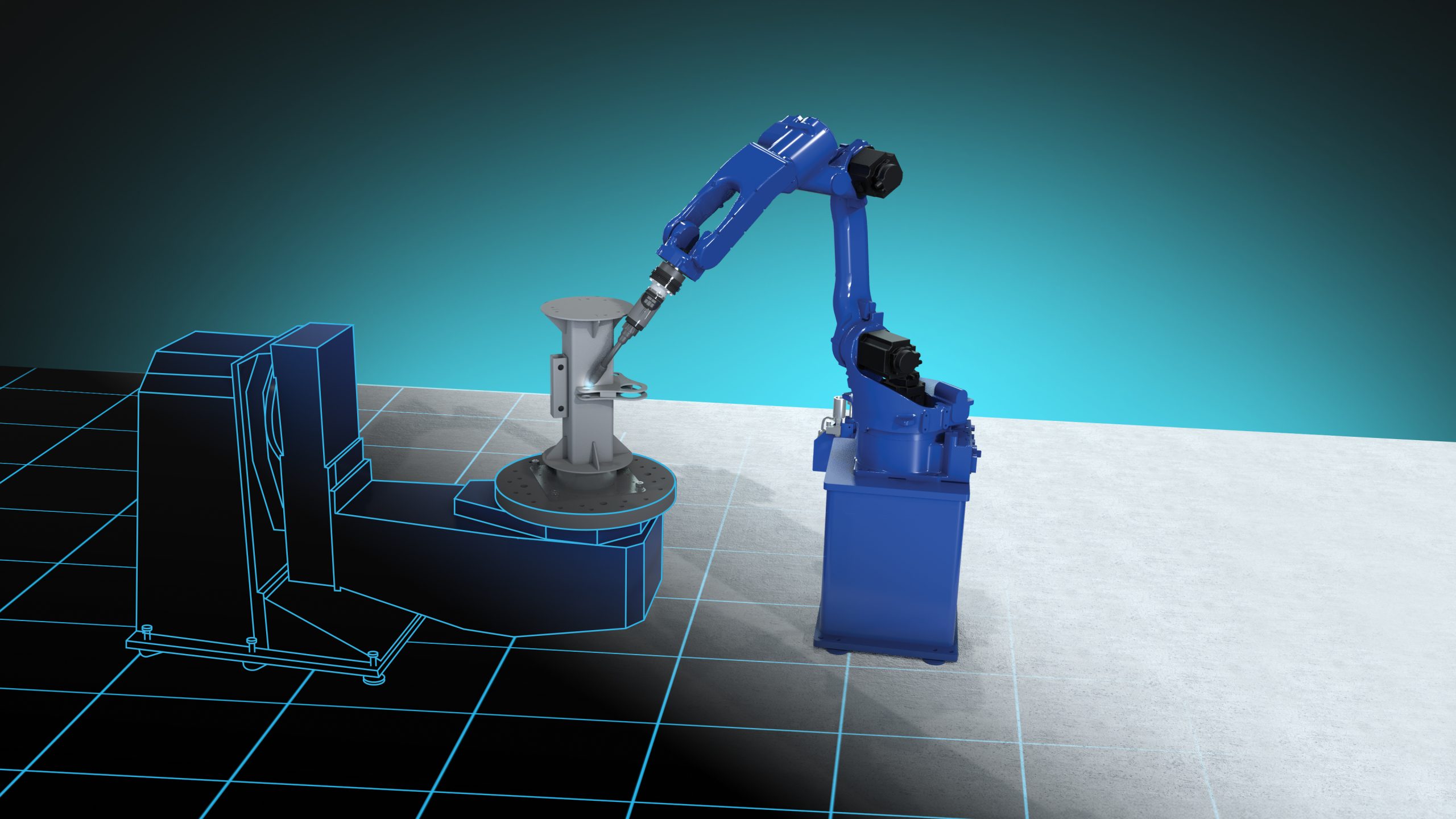
The brand-agnostic OLP market is crowded. Every tool claims to support all your robot brands and all your processes. Most don’t.
When you’re midway through an OLP evaluation, the real differences rarely show up on a feature list. They appear later — when your “multi-brand” tool can’t coordinate two robots, or your “all-process” platform only handles welding, or your pay-per-use pricing doesn’t scale.
This guide cuts through that. It covers what to look for across process breadth, simulation scope, multi-robot capability, post-processor quality, and total cost — with insight from Visual Components application engineers who work with these tools daily.
The question isn’t just which tool is cheapest. It’s which tool stays useful as your operation grows.
What brand-agnostic OLP tools actually do
Brand-agnostic offline programming software lets you program robots from multiple manufacturers without being locked into a single vendor’s ecosystem. Unlike brand-dedicated tools, brand-agnostic platforms theoretically work across your full robot fleet.
In practice, the category divides into three tiers with very different capabilities and price points.
Enterprise tier: powerful, expensive, and ecosystem-dependent
At the top end, some enterprise platforms carry significantly higher annual costs — €30,000 to €50,000 or more — with meaningful add-ons sold separately. They integrate deeply into major PLM ecosystems, which is why they function as defaults in automotive OEMs already running that infrastructure. Trial licenses are rarely available.
Other enterprise options start at €15,000–20,000+ with complex, role-based pricing involving hundreds of configurable modules. Deep integration with broader CAD/PLM suites makes them attractive for organizations already on those platforms — and a poor fit for everyone else.
Mid-market tier: focused and narrowing
Some mid-market tools target integrators at around €20,000 annually. Many have narrowed their roadmaps to focus on laser cutting and arc welding — other processes exist but lack implementation and support depth. Some require additional fees for post-processor development, robot definition files, end-effector definitions, and CAD import capability.
Others were acquired by larger manufacturing companies, with limited publicly available data on current capabilities and pricing.
Entry-level and niche tiers: cheap entry, limited ceiling
Some entry-level tools start around €4,000 plus annual maintenance. They’re well-designed for 6-axis robot kinematics and simple path planning, with user-friendly interfaces and active communities. Where they fall short is in programming depth: post-processor coverage is broad but the implementation is shallow, process-specific command support is limited, and multi-robot coordination is typically unavailable. The programming capability gap between these tools and full OLP platforms is substantial.
Some niche solutions are cloud-based, process-specific, and charge per use after an initial fee. They claim short training times — accurate, but only for simple single-robot cells and a limited range of straightforward product geometries. Multi-robot coordination is typically not a core feature.
Other niche options run €20,000–40,000+ but require months of training to become proficient. Every new component in the library may carry an extra charge, and CAD formats beyond basic standards require add-on modules.
The structural limitations of narrow-scope OLP
Pricing is the first objection in every OLP evaluation. But it’s rarely the most important one. The real gaps appear in four areas.
Process narrowness creates future dead-ends
Most tools in the brand-agnostic OLP market were built around one process and extended cautiously from there.
Some handle only arc welding. That’s it. No cutting, no painting, no material handling. Others narrowed their roadmaps to laser cutting and arc welding — other processes exist in the product but lack the depth that welding and cutting receive. Some cover welding and cutting only. Others handle welding, cutting, and deburring, with no native handling operations.
When your second robot cell is a cutting application, or your third is painting, or a customer requires dispensing — a single-process tool stops being an asset and starts being a constraint.
Robot programming for industrial processes covers how multi-process support changes the economics of OLP for system integrators across welding, cutting, painting, and handling applications.
Visual Components supports all of those processes in one license. No add-ons, no process-specific modules to purchase separately.
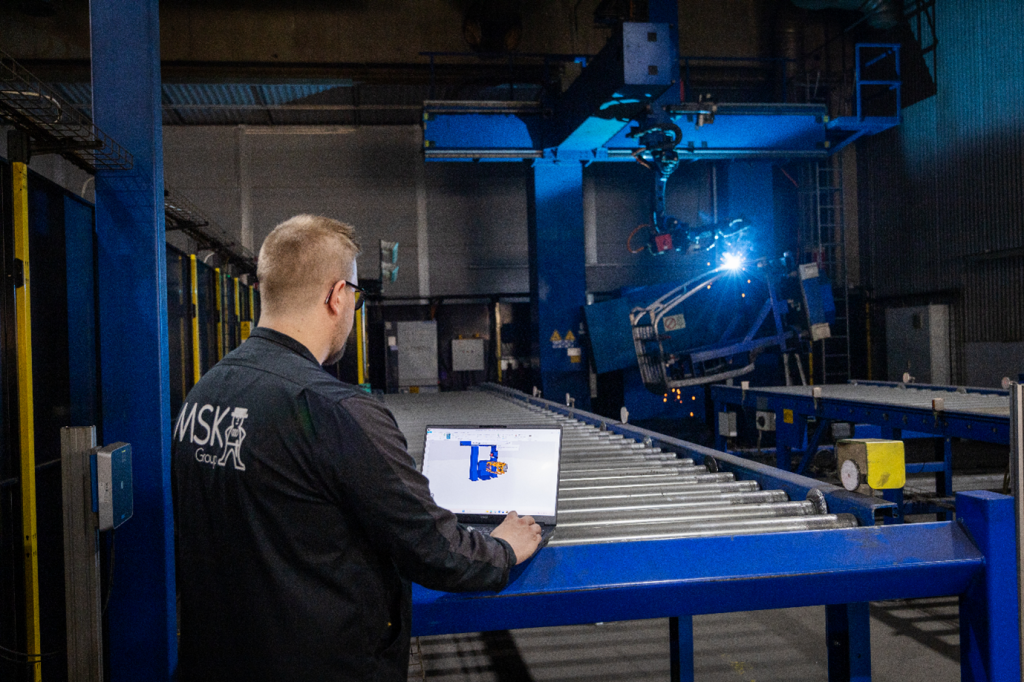
Simulation scope determines how much you can validate before building
Robot offline programming is most valuable when it lets you validate not just the robot path but the entire production context — cell layout, cycle time across a line, material flow, bottlenecks, and equipment utilization.
Some tools are robot-focused by design. The scope difference between a robot-only tool and a full OLP platform — the entire factory versus the robot alone — is significant and acknowledged. No line or factory simulation is built in. Others operate at cell level only. Some confine simulation to checking robot reachability at the cell level, with no statistical analysis and no factory-level view.
If you need to answer “what happens to throughput if we add a second robot?” or “how does this cell affect the line’s overall cycle time?” — these tools can’t help.
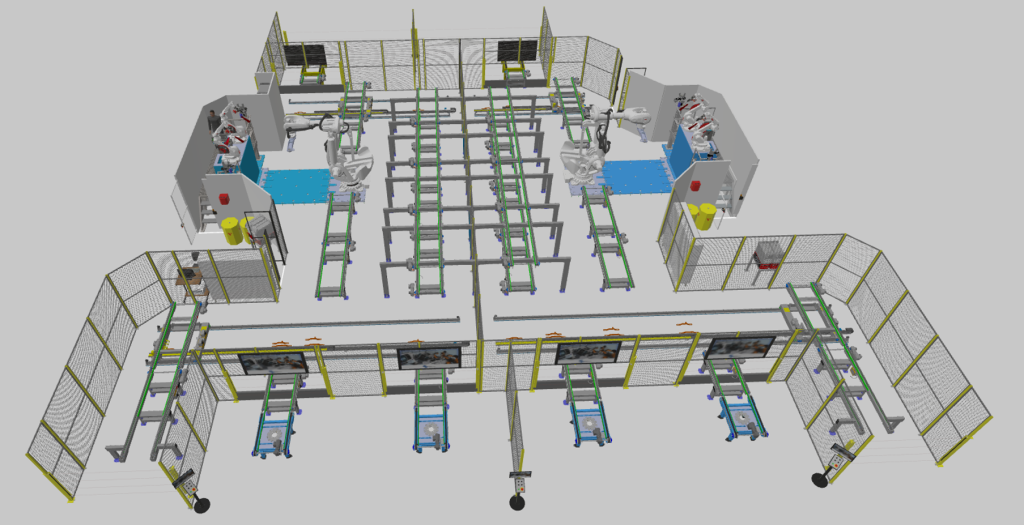
Visual Components simulates cells, lines, and full factories in the same environment. Conveyors, fixtures, AGVs, human operators, and material flow are all part of the same model.
Multi-robot coordination is a capability gap, not a difference in degree
Running multiple robots in the same cell — synchronized welding, coordinated holding and positioning, multi-arm assembly — requires the software to track signal logic, timing constraints, and coordinated paths simultaneously.
Some tools don’t offer multi-robot coordination as a core feature. Others have no signal connection between robots; cell simulation is used for reachability verification only. Some added multi-robot capability only recently.
Visual Components handles full multi-robot coordination: signal logic, synchronized motion with external axes, and coordinated path planning across any brand combination. You can coordinate robots from different manufacturers with the same workflows that apply to single-robot programming.
Multi-robot programming consistently appears in long-form OLP evaluations at major manufacturers as one of the decisive capability gaps between platforms. It’s a VC strength that’s been part of the platform for years, not a recent addition.
Post-processor quality determines whether you own your programs
A robot post-processor translates the virtual program into the code your physical robot controller runs. A good post-processor supports a wide range of functions, handles process-specific commands correctly, and — critically — lets you modify and extend it independently when robot firmware updates or process requirements change.
Some entry-level tools offer broad post-processor coverage but shallow implementation — many supported brands, but limited depth in process-specific commands and customization. Some mid-market tools charge additional fees to develop post-processors for specific robots or process requirements. Others have complicated post-processor builders maintained by small teams.
The dependency created by a poor post-processor creates real cost. If a robot manufacturer releases a new firmware version and your post-processor doesn’t support it, you call the software vendor, wait, and pay for the update. If your welding process requires a new command or parameter combination, same situation. For production environments where robot code needs to evolve alongside process knowledge, that dependency is a serious risk.
Visual Components post-processors cover 22+ robot brands and are fully customizable via Python interface. Technical teams can adapt post-processors to new firmware, new process commands, or custom workflow requirements without calling Visual Components. How offline programming software improves robotic welding efficiency covers post-processor design in the context of real welding applications.
Hidden costs accumulate where feature lists don’t show them
The price you see for narrow-scope OLP is rarely the price you end up paying.
Some enterprise platforms charge separately for automatic path planning and cable simulation — features bundled into Visual Components at no extra charge. Some niche tools charge for every new component added to the library and require add-on modules for CAD file formats beyond basic standards. Pay-per-use pricing accumulates quickly at production volumes. Some mid-market tools require separate purchase of post-processor development, robot definition files, end-effector definitions, and positioner functionality on top of the base system.
The total cost of an OLP platform is the license, plus add-ons, plus the engineering time spent working around what the platform can’t do. Tools that look cheap at initial purchase often end up costing more over a three-year period. The manufacturing skills shortage research documents how robot programming time connects directly to production throughput and labor cost — and why the efficiency of the OLP tool matters more than the license price.
Visual Components: one platform for all of it
Visual Components combines robot offline programming, factory simulation, and virtual commissioning in one platform — at a price point that competes with mid-market tools while delivering capabilities that exceed enterprise options in several areas.
Key capabilities:
- 22+ robot brands with verified, customizable post-processors — Python interface for independent modification; browse the full library in the eCatalog
- All major industrial processes in one license: welding, cutting, painting, handling, dispensing, assembly
- Cell, line, and factory simulation with material flow, AGVs, human operators, and conveyors
- Multi-robot coordination with signal logic across any brand combination
- Built-in path automation (Multi-Path Definition) — comparable features in some enterprise platforms cost extra as add-ons
- Virtual commissioning with PLC connectivity — included, not an extra module
- 30-day trial license — not offered by many competitors in this space
- OEM/whitelabeling capability — unique among the platforms evaluated; used by manufacturers building simulation tools on the Visual Components platform
Feature-based programming makes robot programs brand-neutral. When you move a program from one cell to another, the geometry and paths carry over. You update the process parameters for the new robot brand, run the post-processor for the new controller, and you’re done. The engineering work on the workpiece doesn’t repeat.
The automated OLP programming guide covers how feature-based and model-based programming compound these efficiency gains at scale.
Comparison at a glance
| Feature | Typical enterprise platform | Typical mid-market tool | Entry-level/niche tool | Visual Components |
| Annual pricing | €30k–50k+ | ~€20k | €4k–8k | Competitive |
| Trial available | No | No | Some | Yes (30 days) |
| Processes supported | Multiple | Narrowing | Limited or single | All processes |
| Simulation scope | Line/factory | Cell/robot | Robot or cell only | Cell/line/factory |
| Multi-robot coordination | Yes | Sometimes | No | Yes |
| Post-processor quality | Good | Complicated | Weak | Verified, customizable |
| Virtual commissioning | Add-on | No | No | Included |
| Material flow simulation | Yes | No | No | Yes |
| OEM/whitelabeling | No | No | No | Yes |
| Time-to-productivity | Months | Days | Hours/days | Days |
Five OLP myths that cost engineering teams money
Myth 1: “Entry-level tools are good enough for multi-brand OLP”
Some entry-level tools are strong for what they do: 6-axis robot path planning with user-friendly interfaces and active communities. They aren’t production OLP platforms. No cell or line simulation is built in. Post-processor implementation is shallow. Process support beyond basic motion paths is limited. For engineers who need to evaluate the full production context — not just whether a robot reaches a point — they’re a starting point, not a destination.
Myth 2: “Cloud-based AI makes programming faster”
Some cloud-based tools automate simple, single-robot welding cells for basic geometries and standard joints. For that use case, short training times are realistic. But pay-per-use pricing doesn’t scale well at production volume, multi-robot coordination isn’t available, process support ends at arc welding, and cloud dependency means your programs and settings live on the vendor’s infrastructure. For a single straightforward welding cell at a small job shop, they may fit. For a system integrator or OEM building complex, growing production environments, the ceiling arrives quickly.
Myth 3: “Enterprise platforms are the industry standard for a reason”
They are. Some vendors have built deep ecosystem integration across PLM, simulation, and manufacturing execution. For automotive OEMs already fully committed to a specific PLM stack, certain platforms are a logical default. But at €30,000–50,000+/year with no trial license and expensive add-ons, they price out most mid-market manufacturers and integrators before they evaluate the alternatives. The standard exists because of ecosystem lock-in, not because it’s universally the best value for the price.
Myth 4: “Cheaper OLP tools save money”
They reduce the license line item. They often cost more in total.
Separate simulation software, manual material flow analysis, limited process coverage, high-effort post-processor maintenance, and the engineering hours spent working around platform gaps — these costs rarely appear in the initial pricing comparison. The ROI conversation for OLP has one central question: how many engineering hours does this save, and at what scale? A cheaper platform that saves fewer hours in fewer situations is rarely cheaper when you look beyond the contract.
Myth 5: “We only need welding OLP today”
Today, maybe. In two years, almost certainly not.
System integrators expand into new process types as customers demand them. OEMs add cutting, painting, or handling cells as product lines grow. The manufacturer who buys a welding-only OLP tool today and needs to program a laser cutting cell in 18 months faces a platform replacement or a second license — with all the training, data migration, and workflow disruption that implies.
Multi-robot coordination, factory-level simulation, and multi-process support also become essential as welding operations themselves scale. The evaluation focus has been shifting toward ease-of-use and future flexibility, not just current functionality.
When narrow-scope tools make sense
This comparison isn’t an argument against all narrow tools in all situations. The right tool for the right situation works.
A single-process job shop with one robot cell, stable production, and no expansion plans is a reasonable candidate for a welding-focused tool. Prototyping and feasibility work without production-grade accuracy requirements can justify starting with an entry-level tool. Organizations fully committed to a specific PLM ecosystem at automotive OEM scale have legitimate reasons to run enterprise platforms.
The questions worth asking honestly: How many robot brands do you currently run or plan to run? How likely are you to need a second process type in the next three years? How important is it to modify and maintain your own post-processors without vendor involvement? Do you need factory-level throughput and cycle time analysis alongside robot path planning?
If the honest answers point to growth and variety, a narrow tool is an obstacle you’ll eventually pay to remove.
Frequently asked questions
What is the best brand-agnostic OLP software?
Visual Components is the most complete brand-agnostic OLP platform currently available, supporting 22+ robot brands, all major industrial processes, and combining simulation, OLP, and virtual commissioning in one tool. Enterprise platforms are stronger options for organizations with deep PLM ecosystem investment. Entry-level tools are the strongest option for simple robot path planning on a limited budget.
How much does OLP software cost?
Brand-agnostic OLP software ranges from approximately €4,000/year for entry-level tools to €50,000+/year for enterprise platforms. Some niche solutions add per-use charges on top of the base price. Others require additional module purchases. Visual Components offers competitive pricing with broader scope than enterprise tools and a 30-day trial available.
Are entry-level tools good for production robot programming?
They work well for initial robot path planning and simple 6-axis robot programming. They lack cell and line simulation, have limited post-processor depth, and don’t support multi-robot coordination or factory-level analysis. Production teams typically grow past their scope and need a more complete platform.
What’s the difference between niche welding tools and Visual Components?
Niche welding tools are typically welding-only, cloud-based platforms with pay-per-use pricing and no multi-robot coordination. Visual Components supports all major industrial processes, includes factory simulation and virtual commissioning, has no per-use charges, and supports 22+ robot brands with verified, customizable post-processors.
Does Visual Components offer a free trial?
Yes. Visual Components offers a 30-day trial license for qualified prospects. Many enterprise and mid-market competitors do not offer trial licenses.
Which OLP software supports the most robot brands?
Visual Components supports 22+ robot brands with verified post-processors, including industrial robots, collaborative robots, and autonomous mobile robots. Some enterprise platforms also support broad robot libraries but at significantly higher cost and without trial availability.
Narrow tools solve narrow problems
The OLP market sells the promise of brand agnosticism — the ability to program any robot with one tool. Most tools deliver that promise for one process, in one cell, at one scale.
Visual Components delivers it across processes, across simulation scopes, and across production environments that grow and change. One platform. 22+ brands. All processes. Complete simulation.
Start a 30-day trial to evaluate Visual Components against your specific environment, or request a demo to see it applied to your use case.
Conclusion
Choosing manufacturing simulation software comes down to what your team actually needs to do — and whether a single tool can do it.
For teams that need layout planning, material flow, robot programming, PLC validation, and virtual commissioning in one environment, the data points clearly to Visual Components. It covers more of those capabilities at a competitive price point, offers the only OEM/whitelabeling model in the comparison, and provides a trial that lets you verify fit before committing.
One pricing note worth repeating: the €13,000/year figure covers Visual Components Premium simulation. Robot offline programming is a separate product line (Premium OLP) at a higher price point. If OLP is in your scope, build that into your evaluation.
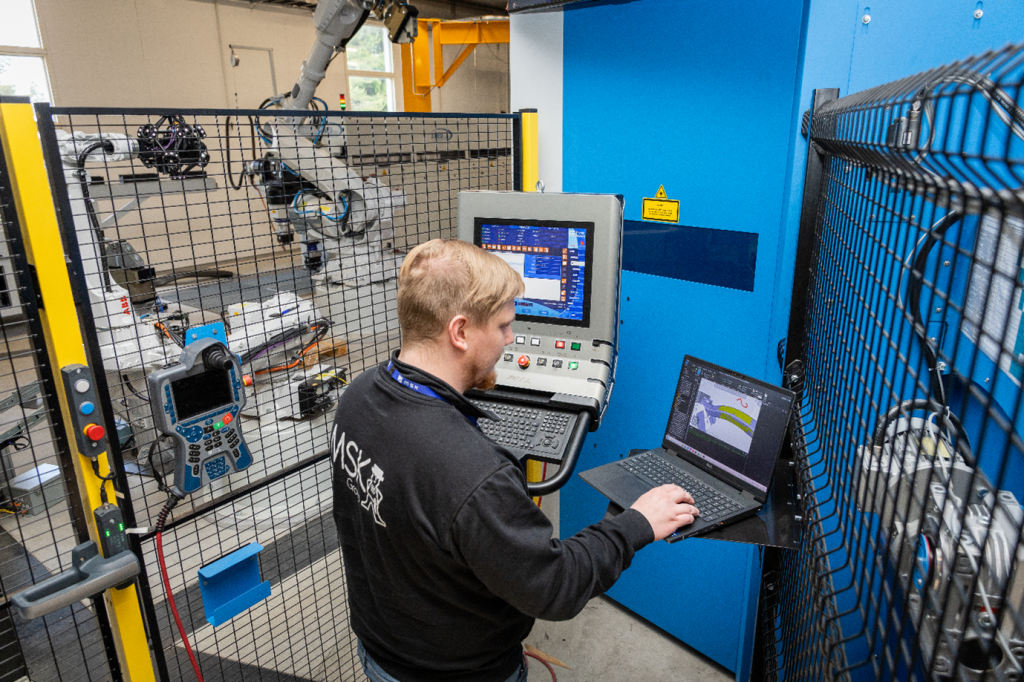
The Sandvik and MSK Finland teams use Visual Components across simulation, robot programming, and intralogistics planning. Read how Sandvik reduced robot programming time and how MSK Finland combined OLP with simulation to see the multi-module workflow in action.
Ready to see if Visual Components fits your needs? Start a 30-day trial or request a demo.
Further reading
How to program a FANUC robot offline with Visual Components
Learn how to build, calibrate, validate, post-process, and deploy a FANUC robot program offline with Visual Components.

Synchronized robot motion: how OLP makes multi-robot programming manageable
Multi-robot cells can weld, handle, and reposition large parts in ways one robot cannot. Offline programming gives engineers one place to program the complete system and find problems before commissioning.
Single-brand OLP tools vs. Visual Components: what system integrators actually lose
Brand-dedicated OLP tools can be free for customers. But for system integrators and OEMs, brand lock-in and robot-only scope create hidden costs. Here's the fact-based comparison.