Introducing Visual Components 5.1 – Orchestrate the floor with ease
Simulate large factories with smarter mobile robot navigation, reliable physics, and real controller logic. Visual Components 5.1 makes it easier to simulate large factories with mobile robots, accurate physics, and real controller logic. Fewer workarounds, more reliable results. This release upgrades movement, physics, and controller connectivity.

The latest version 5.1 of our products can be activated by existing 5.0 product keys for customers with a valid maintenance agreement. Upgrading is easy—start here.
Smarter movement at scale
If you’ve simulated a busy factory floor with AGVs, AMRs, forklifts, and people, you know how quickly things fall apart. Resources clip through each other. Movement flickers. Custom navigation scripts hold together until the fleet grows, then they don’t. Realism and scalability have always fought each other.
Improved resource navigation in Visual Components 5.1 changes that. We rebuilt pathfinding, local steering, and dynamic obstacle avoidance using the same technology behind large-scale game environments. Mobile resources now move more naturally, respond to their surroundings, and reliably avoid each other.
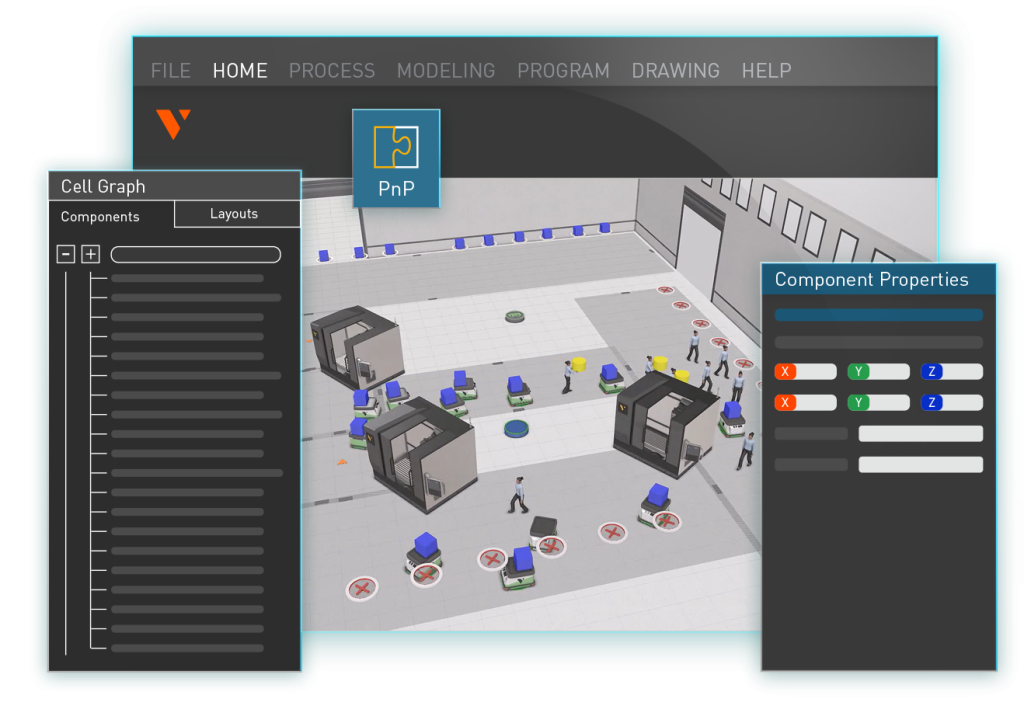
Dense, multi-resource simulations stay stable over long runs. Whether you’re running a warehouse with dozens of AMRs or a factory floor with mixed traffic, you get stable, believable movement without scripting workarounds.
Our parent company KUKA has been using this technology to simulate hundreds of AMRs in factory layouts. The simulation runs roughly 10 times faster than before, and the robots move smoothly without collisions. Like a self-driving car, but for your factory floor.
Factories are adding more mobile robots, not fewer. In the near future, those robots won’t just follow pre-programmed paths. They’ll observe with vision and lidar, then make autonomous decisions about how to pick, place, and move. Accurate movement simulation is how you get ready for that.
The improvements to resource navigation are included in all Visual Components products.
More reliable physics for real-world behavior
Physics bugs are subtle until they ruin a simulation. In large or complex layouts, inconsistent stacking, performance drops, and behavior that shifted between runs made results hard to trust.
Visual Components 5.1 upgrades the physics engine to PhysX 5.5. Products move, interact, stack, collide, and flow more accurately, especially in large layouts. You don’t need to redesign existing layouts to benefit.
For intralogistics simulations in particular, more accurate physics means conveyor flows and material handling scenarios better reflect what you’d see on the real factory floor.
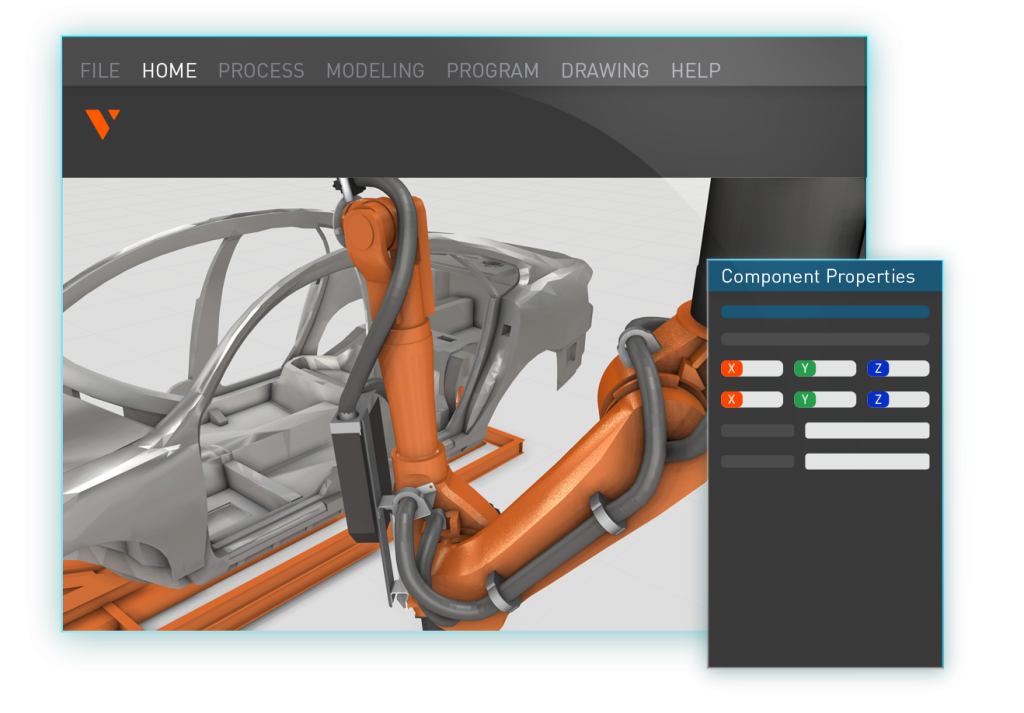
The improvements to the physics engine are included in all Visual Components products.
Deeper controller-accurate validation
Your simulation works best when it connects to the real control logic running your production systems. Visual Components 5.1 expands controller connectivity on two fronts: PLCs and robots.
Allen-Bradley PLC connectivity
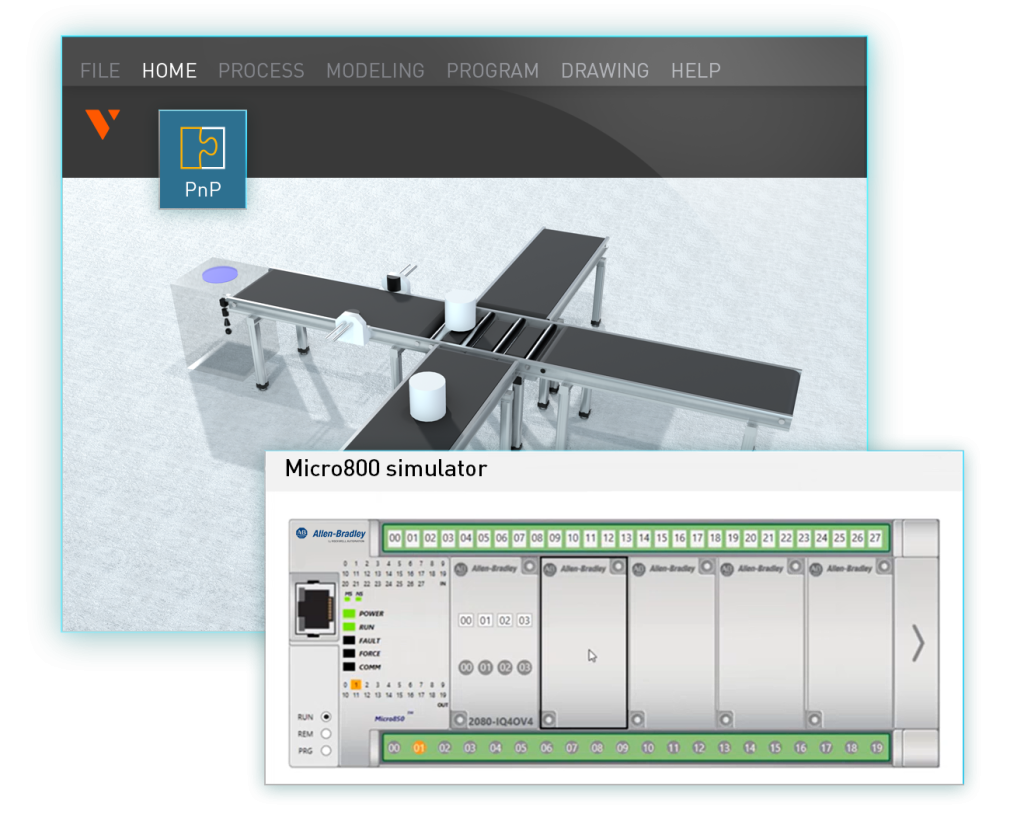
You can now connect real or emulated Allen-Bradley PLCs directly to a Visual Components simulation. The PLC logic drives the simulated system in real time: sequencing, timing, and signal interactions.
That means you can test and debug PLC programs before physical equipment exists. Validation moves earlier in the project and off the shop floor, away from the tight windows that physical commissioning requires. Less risk, shorter startup timelines. The Allen-Bradley PLC connectivity is included in Visual Components Premium and Premium OLP 5.1.
Nachi and Epson robot connectivity


Robot brands like Nachi and Epson are often underserved by vendor simulation tools. The new connectivity plugins bring them into the same virtual commissioning workflow used for other brands in Visual Components.
You can read and write I/O signals, validate real controller behavior, and simulate these robots as part of full production layouts, not in isolation. Testing a robot cell on its own tells you little. Testing it as part of the full system is where the useful answers come from. The Nachi and Epson robot connectivity is available in Premium and Premium OLP variants of 5.1.
What 5.1 means for your factory
Deciding how many AGVs or AMRs you need is harder than it sounds. Too few and you miss production capacity. Too many and you get congestion and blocked lines. With improved navigation and physics, you can run experiments in simulation to find the right number before you buy hardware.
The same applies to safety. When humans work alongside robots and mobile equipment, simulation lets you verify what happens before anyone steps onto the floor.
Visual Components 5.1 is built for teams running large, realistic simulations where movement, physics, and controller validation all need to actually work. Automotive, electronics, logistics, healthcare: if you’re combining traditional automation with mobile robotics, this release is for you.
If you’re in the market and looking for manufacturing simulation, OLP software, or both, contact us today to learn how we can help you orchestrate the manufacturing floor as easily as possible.
Further reading

Mike Strahlman on what comes next for Visual Components
As the new CEO of Visual Components, Mike Strahlman shares his vision for the future of manufacturing simulation, digital twins, and automation planning. In this interview, he explains why factories...
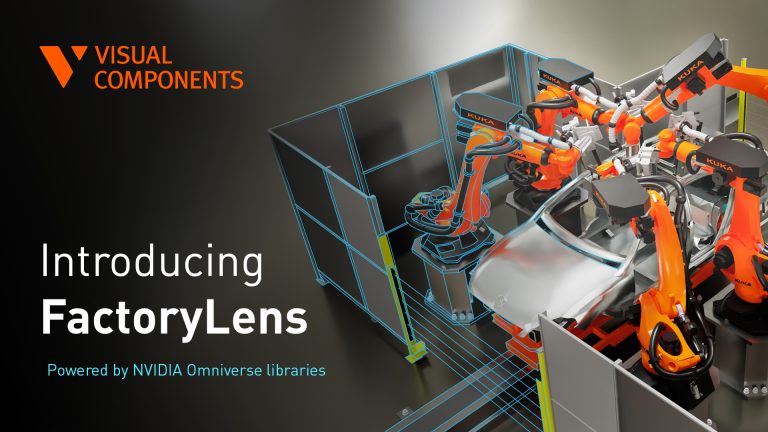
Introducing FactoryLens: turn factory simulations into realistic customer experiences
Visual Components launches FactoryLens, extending its collaboration with NVIDIA for industrial digital twins. FactoryLens helps system integrators and machine builders present Visual Components simulations with realistic materials, lighting, and shadows,...
Visual Components partners with CADENAS to deliver millions of vendor-verified CAD models for 3D manufacturing simulation
Seamless access to verified CAD models At Visual Components, we strive to improve how our users plan, simulate,...