Denso Manufacturing Czech boosts leak testing throughput with Visual Components simulation
Denso Czechia used Visual Components to simulate and optimize a key leak testing line for heater exchangers. By testing a new routing logic in a digital twin first, the team boosted automated tester utilization and improved line stability, all before making changes on the shop floor.
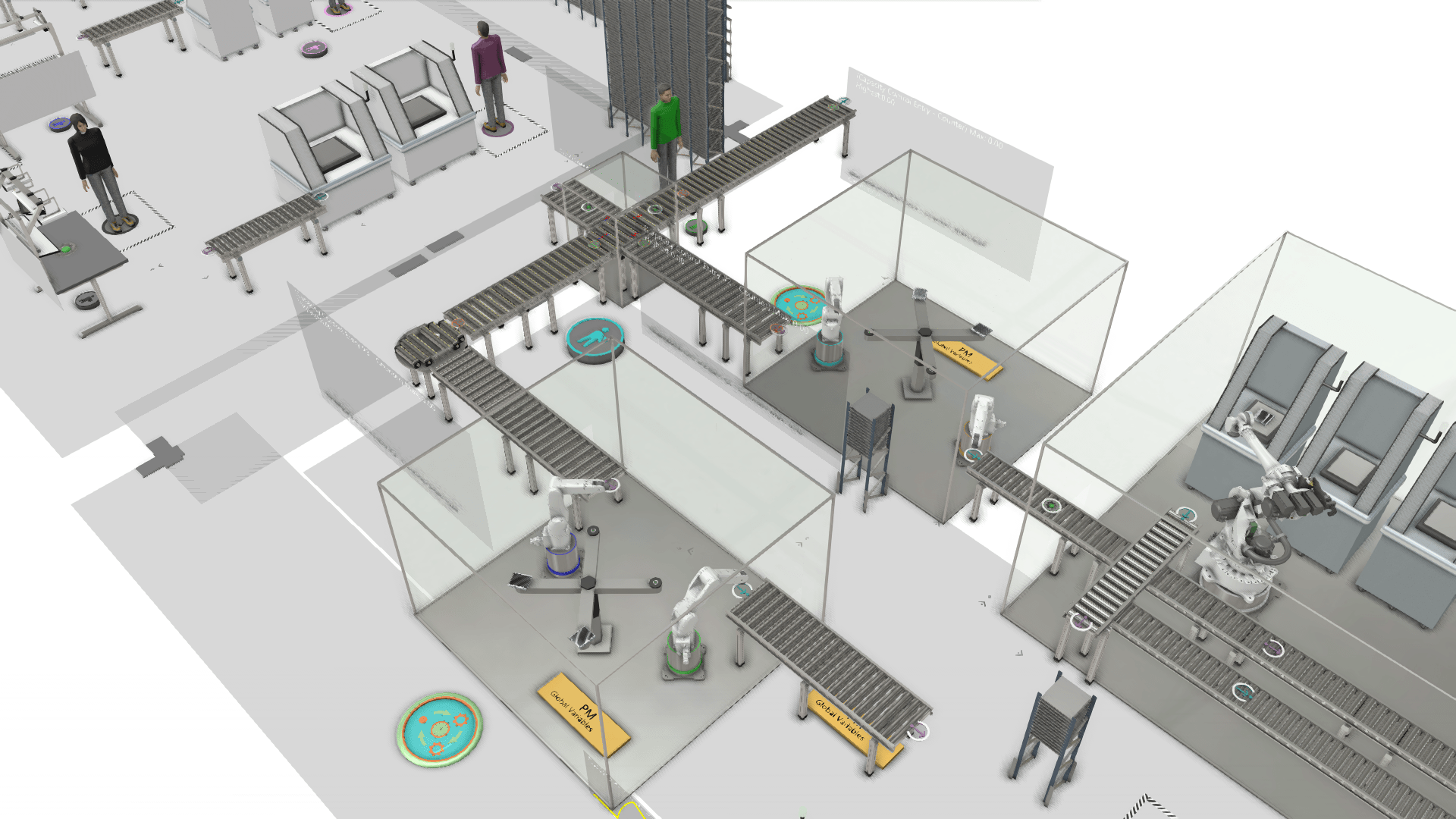
Test line for heater exchangers
Denso Corporation is one of the world’s largest automotive parts suppliers, producing everything from engine components to climate control systems. In the Czech Republic, Denso Manufacturing Czech (DMCZ) specializes in automotive air-conditioning units and heater components. At this facility, Jaroslav Živnůstka, Digital Twin Trainee, and his team were tasked with improving a critical quality process: the helium leak testing line for heater exchangers.
Manual routing meets its limit
On DMCZ’s heater exchanger production, every unit must pass a helium leak test on the HTR#2 line, which consists of several testing stations. Previously, parts were routed by type to specific testers: one station for the X variant, another for Y, another for Z, and so on. This fixed assignment meant operators manually shuttled parts to the designated tester for each model. In theory, each tester handled its own product type; in practice, this setup was inflexible and prone to inefficiency. If one product type spiked in demand or a tester went down, bottlenecks formed while other stations sat idle. Operators often found themselves with a queue of parts waiting at one machine, even as an adjacent tester remained free with nothing to do. The manual, rigid routing made the line fragile, it couldn’t easily rebalance work when conditions changed, leading to both bottlenecks and underutilized equipment.
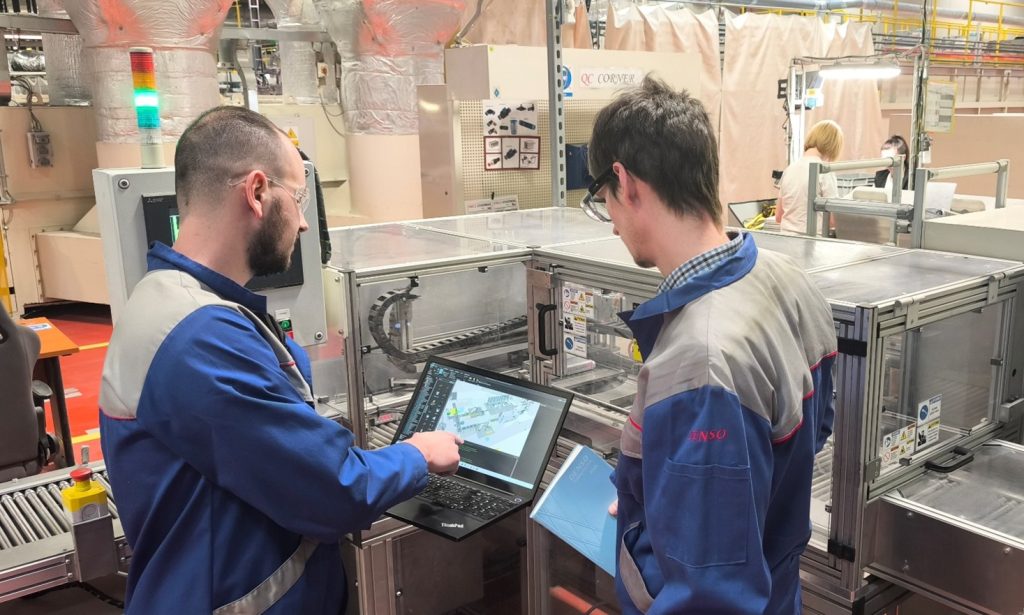
“Our goal was to replace the rigid product-to-testing machine assignment with a flexible routing logic that automatically balances the load across stations. The previous setup created bottlenecks whenever demand shifted or one of the processes went down. We wanted a system that adapts in real time and keeps all testing machines consistently utilized”.
Jaroslav Živnůstka, Digital Twin Trainee, Denso Manufacturing Czech
Jaroslav and his team knew there was a better way. With Denso’s high daily production volumes, even minor inefficiencies could translate into significant lost output. They envisioned a more dynamic system: instead of fixed routes by product type, what if a distributor could direct each part to any available tester based on real-time capacity? In other words, rather than three separate queues (one per tester type), create a smart merging system that always sends the next product to the next free tester. This approach promised to eliminate idle time on the testers and prevent long queues, effectively “breaking” the bottlenecks by balancing the load across all machines. However, implementing such logic in a live production line was risky without proof it would work. Would different heater models still be tested correctly? Could the control system handle the dynamic routing? Before rebuilding conveyors or rewriting PLC code, the team needed to be sure their idea would deliver the expected benefits.
Simulating a smarter distribution system
To de-risk the change, Jaroslav turned to simulation. Using Visual Components’ 3D manufacturing simulation platform, he built a detailed digital twin of the entire HTR#2 leak testing line: the conveyors, testing machines, capacity sensors, and logic of the leak test line. Almost every aspect of the current process was modeled: the different heater exchanger variants, their arrival rates, the cycle times of each leak test, and even the operator interactions for loading and unloading. By reproducing the line virtually, the team could experiment with the new “smart distributor” logic in a safe environment, observing how the system would behave without disrupting actual production.
In the simulation, an algorithm acted as the dynamic distributor, and with the directing each incoming part to whichever tester was free or had the shortest queue, rather than a predetermined fixed route. Visual Components, with it’s open platform, allowed Jaroslav to script this routing logic, along with functioning capacity sensors, and watch it in action. They ran the digital line under various scenarios: normal production rates, peak loads (to stress-test for worst-case backlogs), and even simulated downtime of a tester to see how the system would adapt. The digital twin let them play out the new strategy over and over, quickly tweaking the logic each time they spotted an issue.
Crucially, this virtual trial-and-error built confidence in the solution. They also fine-tuned the control rules: ensuring a part would never be sent to an incompatible tester (in case certain stations had unique tooling or calibration for a specific model). By the end of this simulation phase, Jaroslav and his colleagues had a well-tested distributor logic that kept the line flowing under all tested conditions. They had essentially debugged and optimized the new process in the digital realm, without any downtime or physical modifications to the real line.
Smoother flow and higher throughput
“The simulation program helped us better understand the system and verify theoretical knowledge in practice without the risk of real errors. It also made it easier to defend the functionality of the solution and to create clear visualizations for presentations”.
František Manlig, TIE Specialist, Denso Manufacturing Czech
When the simulation results came in, the benefits of the dynamic distribution approach were compelling. The previously underutilized automatic testers saw significantly better use. In fact, the busiest tester could now process roughly +70 extra parts per hour thanks to the balanced routing. Meanwhile, operators who had spent time manually moving products between lines found would find their roles streamlined: the automated conveyor distributor could take over much of that work, freeing operators to focus on quality checks and other tasks rather than acting as traffic cops for products. Overall, the line’s flow became smoother. Instead of stop-and-go waiting at individual testers, parts moved steadily. Instances of one tester being overwhelmed while another stood idle virtually disappeared in the simulation runs.
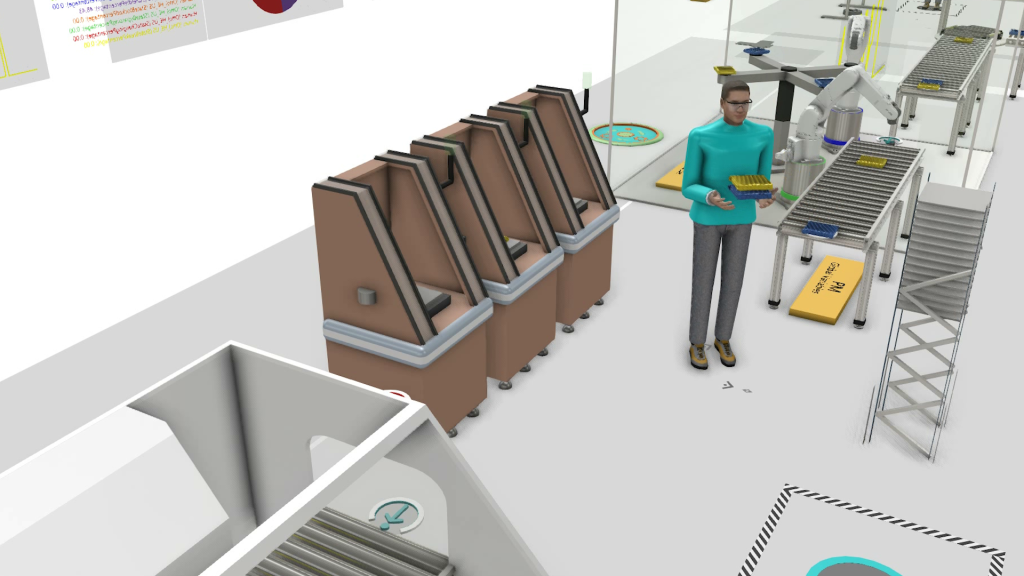
The data from the digital model showed improvements not only in throughput but in consistency. Cycle times across the three tester stations evened out, and the variance in tester utilization dropped markedly – an indication that all equipment was being used closer to its potential. In manufacturing terms, the process was now more balanced. And by catching these insights in simulation, the team avoided trial-and-error on the real line. They identified the optimal controls and layout adjustments beforehand, which meant that once they were ready to implement, there would be few surprises.
“The simulation gave us a reliable way to evaluate process changes before touching the real line. It allowed us to compare multiple production scenarios quickly and see how the system behaves under different conditions. This reduced uncertainty, supported faster decisions, and gave us greater confidence when implementing improvements”.
Michal Humpolák, Technology Supervisor, Denso Manufacturing Czech
Equally important, the simulation exercise gained buy-in from other stakeholders at the plant. Seeing a 3D model of the line where colored heater exchangers zipped to whichever tester was free helped everyone visualize the new concept. It was no longer an abstract algorithm but a tangible system they could virtually watch. This made it easier to communicate the changes to management and operators alike, making sure everyone understood how the new process would work and why it was better.
From digital twin to real-world improvements
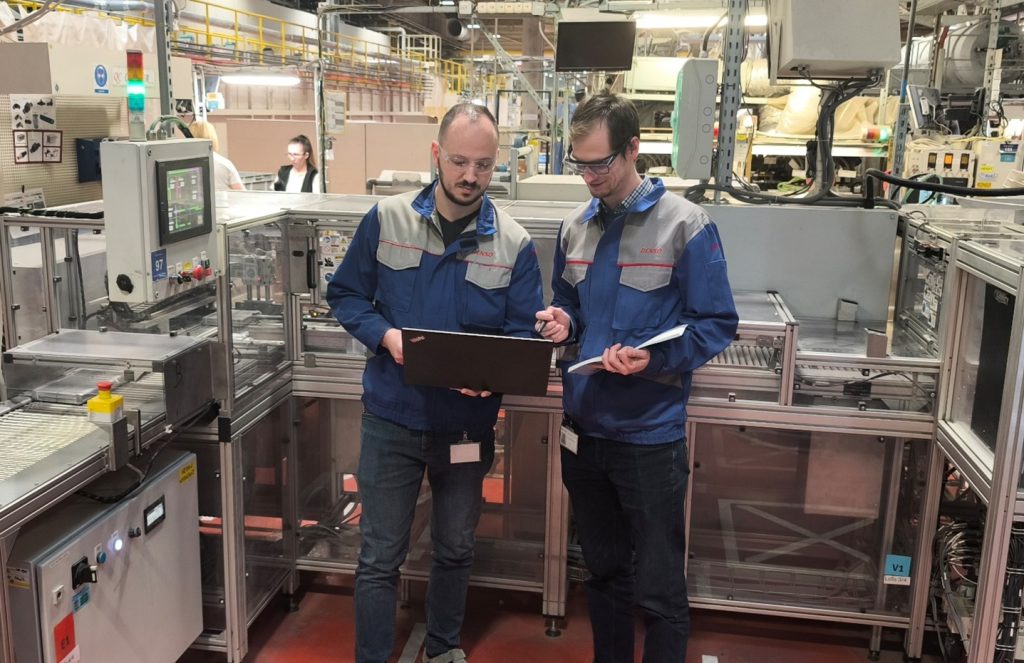
As another project, we would like to use VC software to continue the implementation on the HTR line. Since we are going to consolidate operator’s jobs, it is important for us to verify how much this will affect the working operators. At this time, we want to focus on ergonomics and local muscle strain, which will influence the categorization of work for individual work positions. Therefore, we would like to use the VC framework to evaluate these changes before we proceed with the necessary changes.
Vilém Bartoň, Production Engineering Section Manager, Denso Manufacturing Czech
After proving the concept virtually, Jaroslav and the DMCZ team will move to implement the changes on the real HTR#2 line. The distributor logic developed in Visual Components will be rewritten for the line’s PLC (Programmable Logic Controller), essentially translating the simulated algorithm into the machine code that would control real conveyors and gates.
The immediate goal of the project was to increase automation and eliminate the pain points of the old manual system. Looking ahead, the team has an eye on even higher throughput. With further refinement, they estimate the leak test line could potentially reach 21,000 parts per day throughput in the future. Reaching that number may require additional optimizations or parallelization down the road, but the new flexible distribution is a critical first step toward that benchmark. More importantly, the line is now built for adaptability. As production demands change or new heater models are introduced, the dynamic routing logic can accommodate them with minimal changes. And if they want to test any changes to the line, they can revisit their digital twin built with Visual Components.
About Visual Components
Founded by a team of simulation experts and amassing over 20 years in business, Visual Components is one of the pioneers of the 3D manufacturing simulation industry. The organization is a trusted technology partner to a number of leading brands, offering machine builders, system integrators and manufacturers a simple, quick and cost-effective solution to design and simulate production processes and offline robot programming (OLP) technology for fast, accurate and error-free programming of industrial robots.
Want to learn more about the benefits of our solutions for your business? Contact us today!
Denso case study FAQ
A digital twin is a virtual model of a physical object or system, used to replicate its behavior and performance in a computer environment. In manufacturing, a digital twin can mirror an entire production line or a single machine. Sensors or real data can feed into the digital twin to keep it accurate.
In an automated line, a distributor is a mechanism (either a machine or a control logic) that directs products down different paths. Think of it like a traffic cop for parts on a conveyor. A dynamic distributor means this routing isn’t fixed; it decides on the fly based on which tester is free or least busy. Distributors can be physical devices like diverter conveyors or purely logical rules in the control software
Simulation is great for spotting issues before they happen. Whether it’s a bottleneck in a line, machines sitting idle, or figuring out the best layout for a new process, simulation helps teams test ideas without the risk or cost of trying them live.
Manufacturing simulation software allows companies to create a digital model of a production system in order to test layouts, robot motion, material flow and key performance indicators such as cycle time and throughput before anything is built physically.
Read more here.
Not at all. While it’s great for large projects, simulation is just as useful for small tweaks, like adjusting buffer sizes, testing new shift patterns, or experimenting with minor routing changes. Even small improvements can add up to big gains.
Not necessarily. Many modern simulation tools, like Visual Components, are built to be used by engineers and planners without coding experience. You can build, test, and analyze scenarios using a visual interface and drag-and-drop tools.