Optimizing manufacturing with simulation and robot offline programming
Manufacturers are increasingly relying on simulation and robot offline programming to master variant diversity, improve quality and keep cycle times predictable. This article explores how simulation, digital twins and offline programming help companies move from idea to implementation, enable batch size 1 production and modernize both new and existing factories.
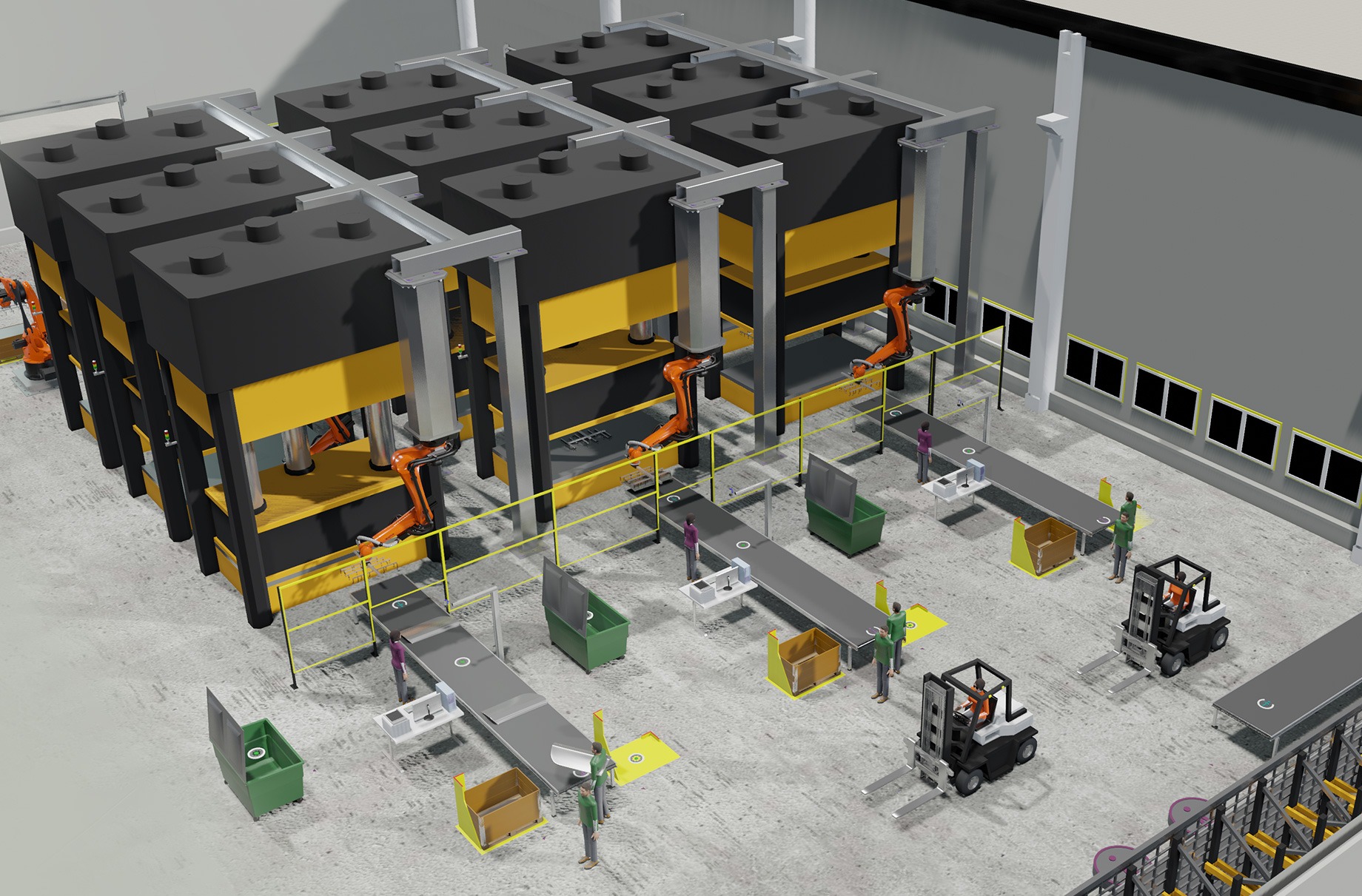
Manufacturing is shifting toward higher product variety, shorter lead times and greater demand for customization. Customers expect more variants, faster delivery and consistent quality, often without higher costs.
This creates a fundamental challenge for manufacturers: how to increase flexibility without sacrificing productivity or predictability. A key enabler is the combination of manufacturing simulation and robot offline programming, which allows companies to test, validate and optimize production systems digitally before committing time, capital and resources on the shop floor.
By moving critical decisions upstream, manufacturers can anticipate issues before commissioning or ramp-up. This is increasingly important as batch sizes shrink and product variants grow, making trial-and-error approaches on the shop floor less practical.
In a recent podcast with MM MaschinenMarkt, Heiko Obmann, Territory Sales Manager DACH at Visual Components, discussed how simulation and offline programming help manufacturers increase efficiency and flexibility in modern production environments.
Manufacturing simulation as the foundation for better production decisions
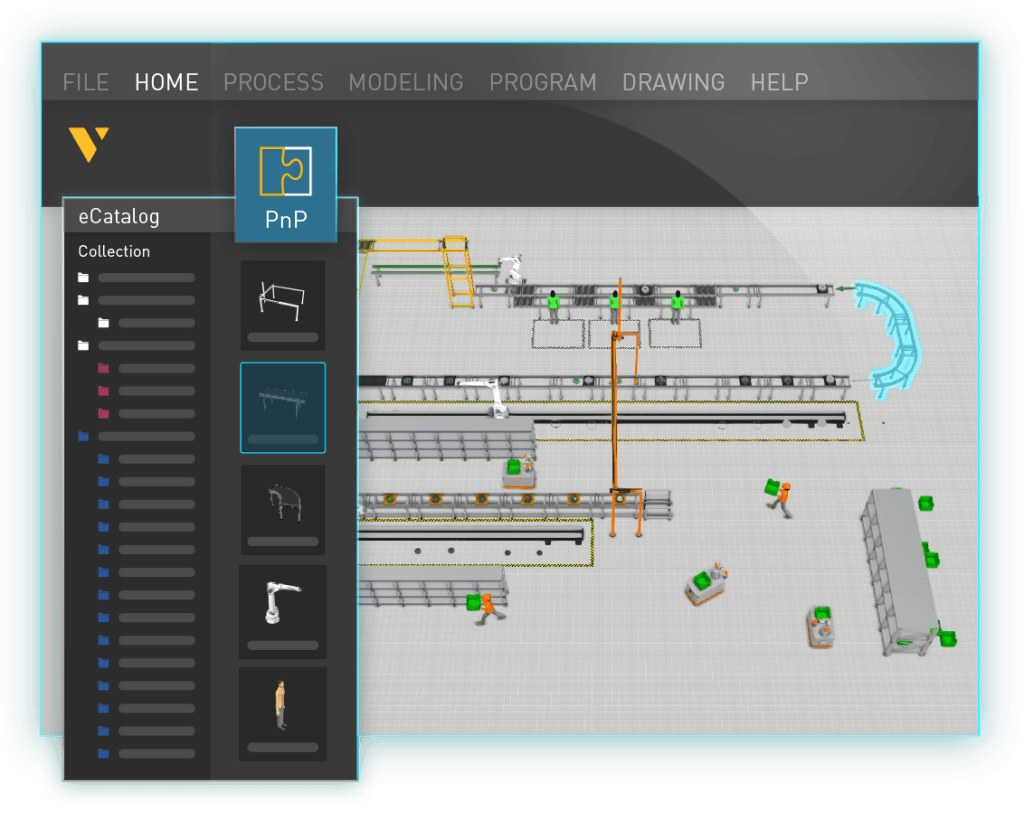
Manufacturing simulation plays a central role in understanding how a production system behaves as a whole, beyond individual machines or robots. Instead of focusing only on individual robots, manufacturers can model complete production workflows, including material flow, buffers, cycle times and interactions between machines. This system-level view makes it possible to evaluate different layout concepts, sequencing strategies and levels of automation before anything is physically installed.
Digital twins created through simulation allow engineers to answer practical questions early on. Can the required cycle time be achieved? Where are the bottlenecks? How sensitive is the process to variation in part geometry or arrival times? By running multiple scenarios, manufacturers can compare alternatives and make informed trade-offs between flexibility, throughput and investment.
Importantly, simulation is not limited to greenfield projects. Existing production lines can also be recreated digitally, providing transparency into processes that may have evolved over years. This creates a shared understanding across engineering, operations and management and establishes a reliable basis for optimization and future changes.
Robot offline programming versus teach pendant programming on the shop floor
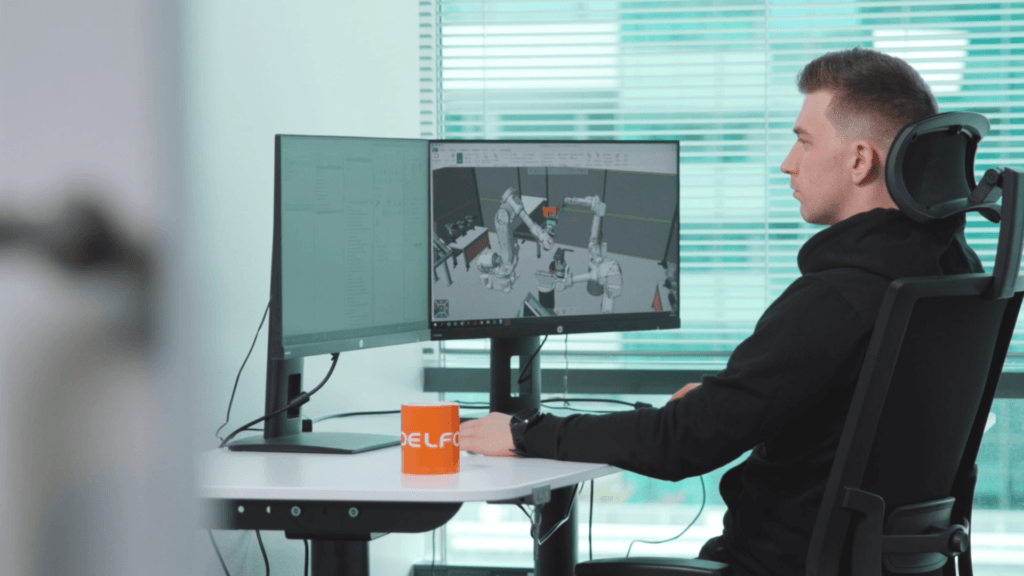
Robot offline programming creates, simulates and validates robot programs in a virtual environment, while teach pendant programming requires manually guiding the robot and defining points directly on the physical shop floor. Teach pendant programming requires physical access to the robot and often blocks production during programming and testing. While this approach can work for simple, repetitive tasks, it quickly becomes a bottleneck when products change frequently or when processes become more complex.
Robot offline programming separates robot programming work from on-site production and enables programming to take place independently of the shop floor. Robot paths, process parameters and sequences are created and tested in a virtual environment. This significantly reduces system downtime and allows production to continue while new programs are prepared. When the program is finally transferred to the robot, it has already been validated for reachability, collisions and kinematics, reducing the need for manual touch-up.
For manufacturers, this means faster commissioning, more predictable ramp-up phases and a higher likelihood of first-time-right production. Offline programming also makes robot programming accessible to a broader group of users, since much of the complexity is handled digitally rather than on the shop floor.
From CAD data and digital twins to executable robot programs
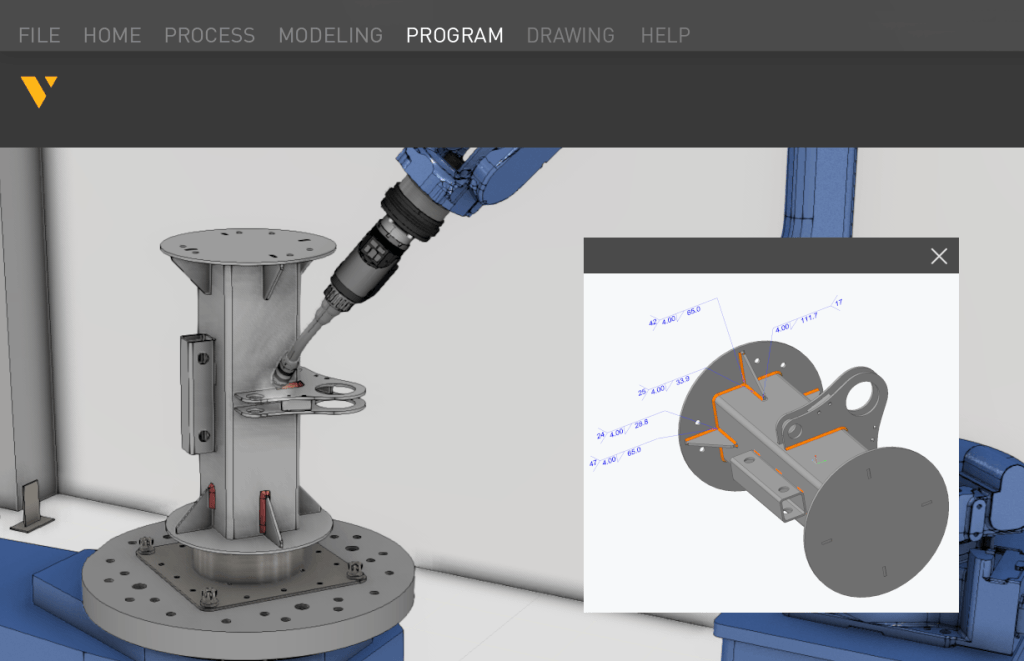
Accurate digital data is a prerequisite for effective manufacturing simulation and robot offline programming. CAD models form the basis for defining products, fixtures and work cells. When combined with model-based definition, manufacturing information such as weld seams, tolerances and reference features can be reused directly in downstream processes.
In the virtual environment, robot kinematics and motion planning are simulated realistically. Axis limits, singularities and reachability constraints are considered early, reducing the risk of surprises during commissioning. This is particularly important for processes like welding or machining, where path accuracy and process order directly affect quality.
Successful offline programming projects depend on close collaboration between the OLP software vendor, robot manufacturers and system integrators. Accurate kinematic models, controller behavior and post-processing ensure that what works in simulation behaves the same way on the real robot. This alignment between the virtual and physical worlds is what makes offline programming viable at scale.
Predictability, quality and cycle time as measurable manufacturing outcomes
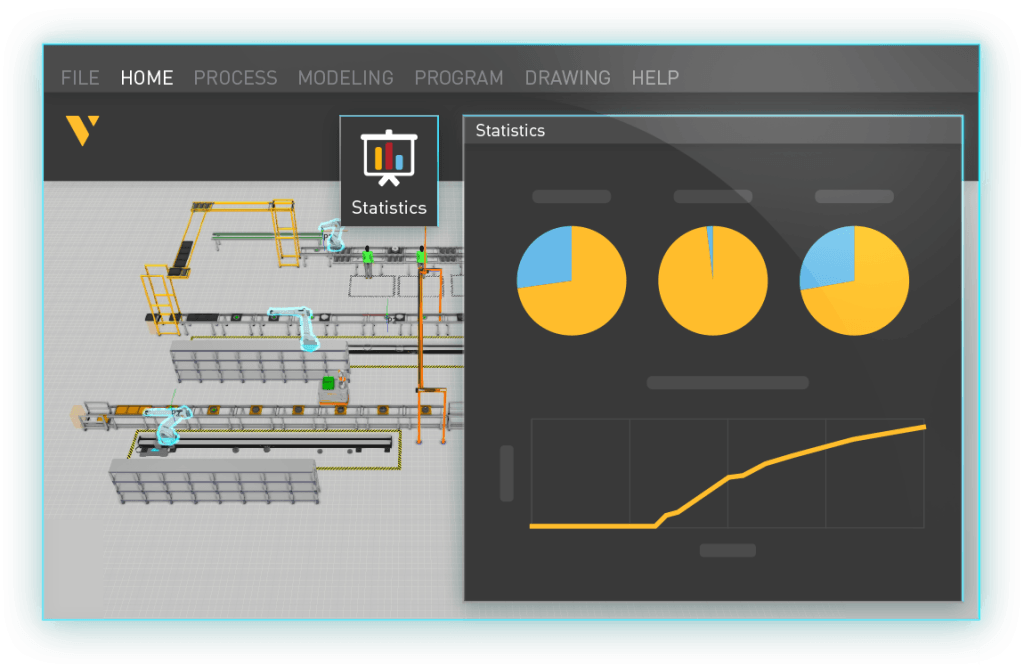
One of the key advantages of simulation-based planning is that it makes performance measurable early on. Cycle times can be calculated and compared, quality risks can be identified and process stability can be evaluated before production starts. This allows manufacturers to define realistic KPIs and assess whether targets can be met under real-world conditions.
By simulating alternative process sequences or robot strategies, engineers can understand how sensitive the system is to variation. For example, changing the order of welds may reduce distortion or adjusting robot coordination may shorten cycle time. These insights are difficult to obtain through physical testing alone, especially when production capacity is limited.
As a result, simulation and offline programming contribute not only to faster start-up but also to more stable long-term operation. Quality becomes more repeatable and deviations can be addressed systematically rather than reactively.
Practical robot programming and simulation use cases across industries
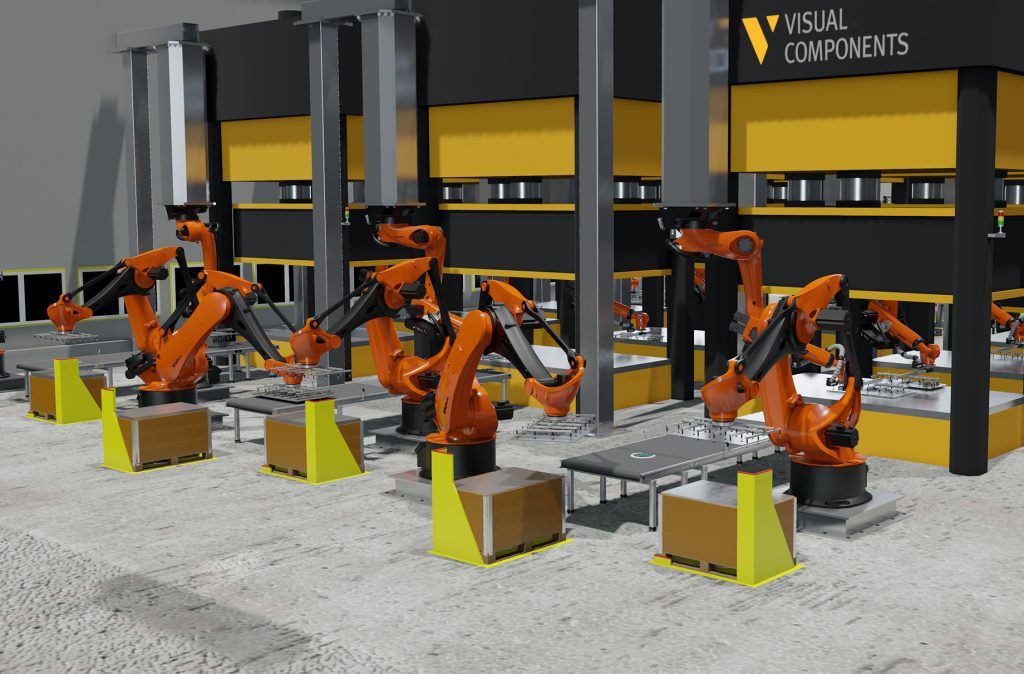
The discussion highlights that simulation and offline programming are relevant far beyond a single industry. In automotive manufacturing, they are well established due to high complexity and tight tolerances. Increasingly, however, they are also adopted in sectors such as heavy machinery, thick plate fabrication and so-called yellow goods.
In these environments, parts are large, tolerances may vary and processes often involve welding, handling and complex fixturing. Simulation helps engineers understand how robots, positioners, grippers and sensors interact and how variation affects the overall process. Offline programming enables efficient preparation of robot programs even when products change frequently.
For small and medium-sized enterprises, the entry barrier is lower than often assumed. Many start with focused use cases such as gripping, mounting or welding a limited range of parts. By simulating these processes and programming robots offline, they can achieve quick payback and gradually expand automation without large upfront risk.
Retrofitting and modernizing existing brownfield production systems
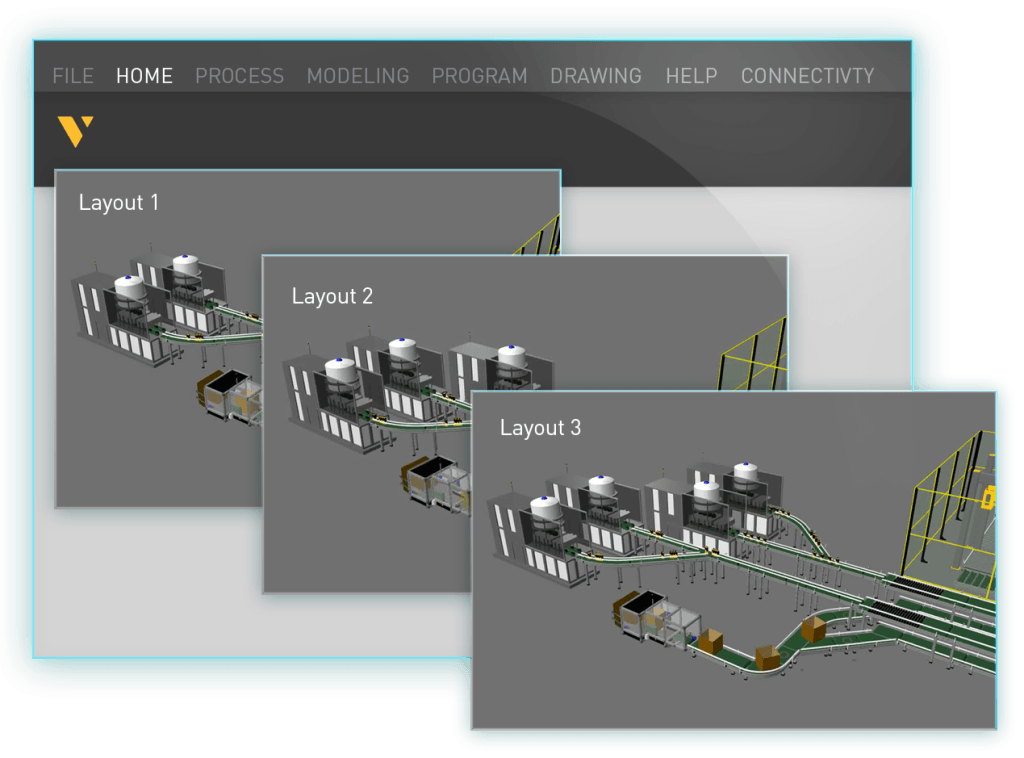
A common misconception is that simulation and offline programming are only useful for new production lines. In practice, many projects focus on brownfield environments. Existing robots and equipment can be recorded, measured or scanned and then recreated digitally.
Once a digital representation exists, manufacturers can experiment with changes virtually. New products can be introduced, layouts adjusted or additional automation added without disrupting ongoing production. This approach reduces risk and helps extend the life of existing assets.
The ability to retrofit and modernize is becoming increasingly important as manufacturers seek flexibility without large capital investments. Simulation provides the transparency needed to make incremental improvements while keeping operations stable.
From automation idea to implementation using simulation and offline programming
Moving from an initial automation idea to a running production system requires coordination between multiple stakeholders. Engineering, operations, system integrators and technology providers all need a shared understanding of the process. Simulation and offline programming provide a common digital language that supports this collaboration.
By validating concepts early and reducing uncertainty, companies can shorten decision-making cycles and move more confidently into implementation. This structured approach makes advanced manufacturing strategies such as batch size 1 more tangible and economically viable.
FAQ about manufacturing simulation and offline robot programming
Offline robot programming is the creation and validation of robot programs in a virtual environment rather than on the shop floor. This allows production to continue while new robot programs are prepared and tested.
Read more here.
Offline programming can be highly accurate when the digital model closely reflects the real system. This requires correct robot kinematics, tooling data, fixtures and reference frames. In industries with tight tolerances, offline programming is already standard practice. In environments with higher variation, it is often combined with sensors or adaptive strategies to handle deviations in real parts.
Absolutely. Offline programming allows manufacturers to develop programs for single-piece or low-volume production efficiently. By testing and validating programs digitally, engineers can reduce setup time, ensure first-time-right production and scale processes gradually.
Yes. Existing brownfield production lines can be digitized using CAD models, scans or measurements. Offline programming and simulation can retrofit current robots and systems, enhancing flexibility and efficiency without replacing equipment.
Manufacturing simulation software allows companies to create a digital model of a production system in order to test layouts, robot motion, material flow and key performance indicators such as cycle time and throughput before anything is built physically.
Read more here.
Manufacturing simulation focuses on understanding and optimizing the overall production system. This includes modeling workflows, material flow, station interactions and cycle times. Robot offline programming builds on this foundation by turning validated process plans into executable robot code. In simple terms, simulation defines how the system should work, while offline programming ensures the robot carries out that plan accurately.
Yes. Manufacturing simulation allows teams to test different layouts, sequences and process strategies before anything is physically built or changed. This includes evaluating robot reach and motion, balancing workloads between stations, estimating takt times and identifying bottlenecks early. Optimizing workflows in a virtual environment reduces the cost and effort of changes later in production.

Further reading
Advanced robot offline programming (OLP) workflow for welding: templates and automatic path optimization
Learn how advanced robot offline programming for welding helps manufacturers program robots faster, more consistently and at scale. This guide explains structured OLP workflows, reusable weld templates, welding databases and...
Automated robot programming: automated path creation in minutes
Automated robot programming reduces hours of manual work by shifting path creation and validation to the offline programming software (OLP). This article explains how automated programming works in practice, the...
Complete guide to ABB robot programming and offline programming
Master ABB robot programming with offline programming (OLP). This comprehensive guide explains how to efficiently program MultiMove synchronized welding cells, streamline the OLP workflow and choose the right software, ABB...